Skip to content
ThonRetire
Everyday street scene in Panama

Central America · verified July 2026
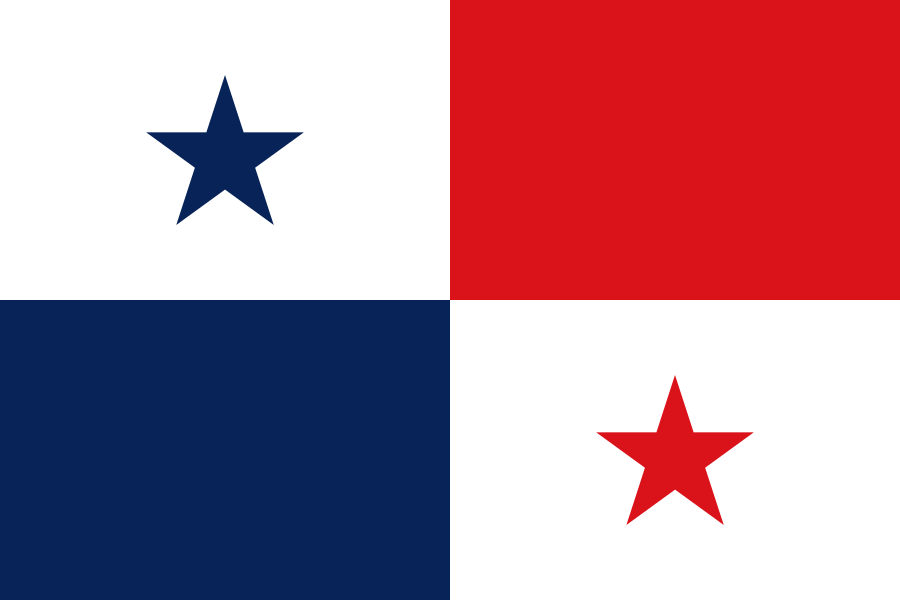
PanamaRetiring in Panama

Panama is the rare place where the paperwork is the easy part. The Pensionado visa needs just $1,000 a month of pension income1, hands you permanent residency almost immediately1, and the territorial tax system means your foreign income simply isn't Panama's business1. Elder-protection law and MIDES licensing are named in search results; official pages did not open cleanly this round, so Panama stays unchecked — no facility register filed. You spend US dollars, you can own property freehold1 — the trade-off is distance1, and local banking will test your patience.

Superscripts link to the source below. Dotted underline marks Thon's own read, not a fact.

What each claim rests on

  1. Panama immigration / Pensionado materialsas of 2026-07 · indicative
Living cost$2,100per month · median $2,100
Tax on your income0%foreign income
Best fit77/100
Flight home30hfrom Sydney
Healthcare7.8/10
77/100

Why this number

Every point is accounted for. Nothing is hidden in a weighting you cannot see.

  1. Base country quality87Panama scores 87/100 before anything about you is applied — visa system, tax regime, healthcare, safety and property rights.
  2. Australian passport-10Worse than average for Australian retirees: ~30h from Sydney — brutal for grandkid visits
  3. Best fit for you77A decision aid, not a prediction. Two people with the same passport can rank these differently — that is the point of showing the working.
  • No double-tax treatyPanama has no tax treaty in force with Australia — the same income can be taxed twice unless you structure around it.

What it means for your money, month one and year twenty-five

A score tells you how well Panama fits. This tells you what lands in your account each month compared with staying in Australia — and then what happens to that figure over the rest of a life, which is where the two answers stop agreeing.

$413/mo net in Panama
+$2,513/movs $-2,100/mo in Australia

Where $4,000/mo goes in Panama

  • Living$3,255
  • Health$333
  • Left$412

The same month, 25 years apart

On the day you land, a pension that keeps rising and one held at the rate you left on pay exactly the same amount. Everything above this line is that day. This is what separates them afterwards.

Monthly pension at 86$6,098vs $3,000 if it is held flat
Gap by age 86$3,098/mothe difference the freeze makes in that single month
Pension not received over 25 years$412,534cumulative, after tax, if it never rises
age 62age 86$380k liquid
Pension keeps rising Pension held at the rate you left on

On these inputs the frozen branch runs the liquid assets down to zero at age 83. The uprated branch still has $379,961 at 86 — so the freeze costs at least 4 years of runway, and the projection simply runs out of years before it can say how many more.

Which branch applies to your pension is decided by the authority that pays it, not by Panama. The published rule for your passport, with its source and the date we opened it, is on what happens to your pension once you leave.

What this projection assumes (projection)
  • Costs are assumed to rise 3% a year, every year, in the currency you spend.
  • Liquid assets are assumed to return 4% a year after fees, with no bad decade.
  • The uprated branch is modelled as rising 3% a year — exactly enough to stand still. The frozen branch does not rise at all. Neither branch is a forecast of what any government will do.
  • Tax is held at the same effective rate for the whole projection; in reality bands, thresholds and treaties all move.
  • Exchange rates are held flat. For a pension paid in one currency and spent in another, that is the single largest thing this projection does not model.
  • This is a scenario, not a forecast. Its value is in the gap between the two branches, not in either number on its own.

A scenario, not a forecast, and not financial advice. It describes what arithmetic does to two published rules over time; it does not tell you where to take a pension.

Panama

Monthly pension
$3,000
Drawdown from assets4% a year on your liquid assets
$1,000
Tax in PanamaForeign pension not taxed here
$0
Private health covertwo people, by age
$333
Cost of livingall-in for a couple
$3,255
Net per month
$413

Australia (home)

Monthly pension
$3,000
Drawdown from assets
$1,000
Tax in Australiaeffective on pension income
$675
Health coverpublic system, no private premium
$0
Cost of living
$5,425
Net per month
$-2,100
How this is estimated (estimate)
  • Effective tax is estimated from the headline band; real tax depends on your residency status, asset structure and the tax year.
  • Assets are drawn at 4% a year — a planning rule of thumb, not a guarantee.
  • Health cover is a private-insurance estimate by age; public enrolment (where allowed) can be cheaper.
  • Cost of living is an all-in monthly figure; a couple is modelled at 1.55× a single person.
  • No treaty is in force for this pair — double taxation is possible if you don't clear home non-residency.

Indicative decision aid, not immigration, tax or financial advice. Confirm with a qualified adviser before acting.

Right for you if

  • Pension-first retirees who want residency locked in fast1
  • Anyone allergic to tax paperwork — territorial means foreign income is untouched1
  • Dollar spenders — no FX risk, ever

Think twice if

  • You fly home often — it's ~30h from Australia1
  • You need slick banking from day one
  • You want four seasons — it's tropical year-round
  • You need a licensed care home you can verify from abroad — sources not yet opened

What the rules say

Every figure here is written into Panama's own immigration, tax or civil code, so you can open the source and check it yourself. Nothing on this page is behind a login.

Who the door opens for

Retirement visaPensionado
Minimum age18 — pension-based
Income you must show$1,000/mo pension
Deposit or savingsNone
Health insurance requiredNo — health cert only
Spouse and dependantsYes — +$250/mo pension each

How long it takes, what it costs to set up

Processing time3–6 months
Set-up cost~$3–6k legal + fees
Renewal cyclePermanent — visit 1×/2 yrs
Permanent residencyImmediate
Path to citizenship5 yrs (3 if married to Panamanian)

Tax, property and what happens to your estate

Tax residency starts at183 days
Property tax0–0.7% · first $120k exempt
Capital gains0% on foreign assets
Foreigners can own propertyYes — freehold
Inheritance taxNo inheritance tax
Forced heirshipNone — free testation

Sources: Servicio Nacional de Migración — jubilado/pensionado (Servicio Nacional de Migración, Panama); Generalidades de la declaración del Impuesto Sobre la Renta (Dirección General de Ingresos (DGI/MEF), Panama) · checked Jul 2026.

Ownership and inheritance rules come from the national civil code; we have not yet linked a primary page for it, so treat those two lines as indicative.

The 13 things about Panama you can't look up

Your net tax burden once the treaty and the local regime are applied. What opening a bank account actually takes, and how many weeks. Private cover priced at your age, not the brochure age. Whether people really keep their first passport here. Capital controls as they work in practice, where the community actually lives, and air and internet by neighbourhood.

Free Thon account, about ten seconds. The same login works on thon.ai.vn and thon.social.

Sign in to unlock

What living in Panama actually costs and takes

Real rents by city, named hospitals, the visa route as a numbered checklist, and a first-90-days plan for banking, tax registration and residency.

Free Thon account, about ten seconds. The same login works on thon.ai.vn and thon.social.

Sign in to unlock

Track Panama

Thresholds move without notice. Get an email the moment a visa or tax fact for Panama changes.

Sources to re-check

  • Panama immigration / Pensionado materials
  • Territorial income-tax framing (DGI summaries)

Indicative decision aid, verified July 2026. Not immigration, tax or financial advice. Thresholds and backlogs move; confirm against the official source before you act.

What insurance you can still buy, by the age you are now

Cost of living gets compared endlessly and this does not, which is backwards: a premium rises with age, but access ends at one. Several policies aimed at long-term travellers stop accepting new members at a fixed birthday and let existing ones renew for life — so the same decision made at sixty-four and at sixty-six produces two different futures, and almost nobody is told the line is there. Below is where the lines fall, checked 2026-08.

  1. Under 60

    Every door is open, and it is the cheapest it will ever be.

    Nothing on the international market is age-gated against you yet, and underwriting at forty rarely asks hard questions. The decision that matters at this age is not which policy — it is whether you start one at all before a condition appears in your file and becomes pre-existing.

    3 policies still write new business at this ageSafetyWing — Nomad Insurance Complete · SafetyWing — Nomad Insurance Essential · Cigna Global
    • SafetyWing — Nomad Insurance CompleteSign-up closes at 64. Members who join before that renew indefinitely.This is the single most decision-relevant sentence on this page for anyone in their early sixties, and it is the one an insurer's own landing page never leads with.
    • SafetyWing — Nomad Insurance EssentialCovers to 69. Priced around US$189/month in the 60–64 band, and per-claim limits are lower than the Complete plan.Cheaper on the monthly line, smaller on the line that pays out. Compare the limits, not the premiums.
    • Cigna GlobalInternational private medical insurance rather than travel cover — no published sign-up ceiling, priced individually after a medical questionnaire.This is the category that still writes new business for people over 65, which is exactly the group the nomad plans above have closed to. It costs more because it is doing something different.
  2. 60 to 64

    This is the closing window, and almost nobody is told about it.

    Several nomad and expat policies stop accepting NEW members at 65 while letting existing members renew indefinitely. Crossing that line without a policy in hand does not make cover expensive — it removes the option. The same five years also decide the price band you are underwritten into for the rest of your life.

    3 policies still write new business at this ageSafetyWing — Nomad Insurance Complete · SafetyWing — Nomad Insurance Essential · Cigna Global
    • SafetyWing — Nomad Insurance CompleteSign-up closes at 64. Members who join before that renew indefinitely.This is the single most decision-relevant sentence on this page for anyone in their early sixties, and it is the one an insurer's own landing page never leads with.
    • SafetyWing — Nomad Insurance EssentialCovers to 69. Priced around US$189/month in the 60–64 band, and per-claim limits are lower than the Complete plan.Cheaper on the monthly line, smaller on the line that pays out. Compare the limits, not the premiums.
    • Cigna GlobalInternational private medical insurance rather than travel cover — no published sign-up ceiling, priced individually after a medical questionnaire.This is the category that still writes new business for people over 65, which is exactly the group the nomad plans above have closed to. It costs more because it is doing something different.
  3. 65 to 69

    The market narrows and the fine print changes shape.

    Products still exist, but the ones aimed at long-term travellers now cap what they will pay per claim rather than simply charging more. Read the per-injury and per-illness limit before the monthly premium — at this age the limit is what moved, and it is the number that decides whether a serious hospitalisation is covered or merely subsidised.

    2 policies still write new business at this ageSafetyWing — Nomad Insurance Essential · Cigna Global
    • SafetyWing — Nomad Insurance EssentialCovers to 69. Priced around US$189/month in the 60–64 band, and per-claim limits are lower than the Complete plan.Cheaper on the monthly line, smaller on the line that pays out. Compare the limits, not the premiums.
    • Cigna GlobalInternational private medical insurance rather than travel cover — no published sign-up ceiling, priced individually after a medical questionnaire.This is the category that still writes new business for people over 65, which is exactly the group the nomad plans above have closed to. It costs more because it is doing something different.
  4. 70 and over

    Travel-style cover largely ends. What is left is local, and it varies enormously by country.

    At this point the international nomad market is essentially closed to new entrants, and the honest answer is that where you go now determines what you can buy. Some countries let a foreign resident buy into the public system at a price no private insurer can match; others leave a large share of retired foreigners self-insuring. That split is the table below, and it is a bigger factor in this decision than tax rates are.

    1 policy still writes new business at this ageCigna Global
    • Cigna GlobalInternational private medical insurance rather than travel cover — no published sign-up ceiling, priced individually after a medical questionnaire.This is the category that still writes new business for people over 65, which is exactly the group the nomad plans above have closed to. It costs more because it is doing something different.

On the ground in Panamaage caps reported

Private cover runs roughly US$100–250/month, and limits start appearing at 65.

The carrier rules above are the insurers’ own published terms. This paragraph is our own estimate of local conditions, not a government publication — how we build estimates.

Descriptive only. We are not insurance brokers and nothing here is a recommendation to buy a particular policy; check age limits, per-claim limits and pre-existing-condition wording on the insurer’s own terms before you decide. These links earn us nothing today — our standing policy on paid links.

If you reach the point of needing care in Panama

This is the part of the decision that cannot be reversed by another flight, and the part the international policies sold to retirees do not pay for — they say so in their own contracts, quoted with page numbers on the long-term care page. What is specific to Panama is narrower and more useful: whether there is a public register of licensed facilities you can search before you commit.

Not yet checked Search still points at Ley 36 de 2016 and MIDES. Official MIDES and Gaceta pages returned bot-rejection or empty PDFs when fetched this round, so Panama stays unchecked — a gap in access, not a finding that no law exists. No licensed-facility register has been opened.

Descriptive only, and deliberately without a cost table: no government body or statistics office in the countries covered here publishes a monthly figure for elder care, and we would rather say so than restate an unsourced range. Layer last reviewed 2026-08-14.

Chosen Panama? Now — which city

One country holds several very different lives. We line the main retiree bases up side by side, cheapest first, with the monthly budget each really takes — and the catch nobody puts in the brochure.

David

$1,100–1,600 — ESTIMATE

Rent $350–600 — ESTIMATE

Working lowland city near Boquete — the cheapest realistic base in the country, with the region's best hospitals right in town.

Suits you if Value-first retirees who want low costs and strong local healthcare, not a scene.

The catch Genuinely hot (mid-30s C most days) and the expat scene is thin — it's a place to live cheaply, not a resort.

Think twice if Anyone who needs a ready-made expat community or can't handle genuine heat.

View David

Boquete

$1,400–1,900

Rent $500–900

Cool mountain town at 1,200m — no AC needed, big established gringo scene, hiking and coffee farms out the back door.

Suits you if Retirees who want cool mountain air, hiking and an instant English-speaking community.

The catch The bajareque mist and weeks of grey rain (Oct–Nov especially) get to people, and the nearest full-service hospitals are 45 minutes downhill in David.

Think twice if Anyone who wilts under grey skies — the bajareque mist and Oct–Nov rain get to people.

View Boquete

Coronado

$1,800–2,500

Rent $550–900

Beach town 80 minutes from the capital with supermarkets, a golf course and a built-in English-speaking network — the easy-mode option.

Suits you if Retirees who want a soft landing — beach, golf, English, capital nearby.

The catch Gringo pricing is real, Panama City crowds pour in on dry-season weekends, and you need a car for almost everything.

Think twice if Anyone on a tight budget who'll resent the gringo pricing and car dependence.

View Coronado

Panama City

$2,000–2,800

Rent $800–1,300

A real capital city — US-dollar economy, direct flights home, Johns Hopkins-affiliated hospital, good restaurants in El Cangrejo and San Francisco.

Suits you if Retirees who want big-city healthcare, connectivity and dining, and can pay for it.

The catch Hot and humid year-round, traffic is brutal, and expat-neighborhood costs creep close to US city prices.

Think twice if Budget retirees and anyone who can't take year-round heat, humidity and traffic.

View Panama City

Outside Panama City, most single retirees live well on 30–50% less than in the US or UK — and it's all in US dollars, so no exchange-rate roulette.

Panama for Australian, American, British and Canadian retirees

The same country scores differently depending on the passport you hold. What moves is not the weather — it is the tax treaty, how your pension is treated once you are resident, and how long the flight home takes when someone gets ill.

Australia From Australia77
Your pension
Super/pension paid to you; Panama doesn't tax foreign income
Local regime
Territorial 0% — powerful IF you clear ATO non-residency (no AU treaty backstop)
Treaty
No double-tax treaty
Flight home
30h from Sydney
Healthcare access
Medicare stops the day you leave as a resident — private ~$100–250/mo; age caps from ~65
Banking and money
Heavy KYC; weeks; bring certified AU docs
Trying it first
Tourist entry ~90–180 days — try Boquete/Coronado first
Days you may spend at home
Stay under ~183 days/yr in AU, and don't keep a 'permanent home' in Australia
  • 0% local tax + Pensionado + freehold + USD
  • ~30h from Sydney — brutal for grandkid visits

All 17 destinations ranked for Australian retirees →

United States From the United States90
Your pension
SS payable; Panama doesn't tax foreign pension
Local regime
Territorial — no local layer, so nothing IRS eats
Treaty
No double-tax treaty
Flight home
3h from the US
Healthcare access
None — Medicare void abroad
Banking and money
Wary post-Panama Papers; expat banks OK
Trying it first
180 days visa-free
  • 3h from Miami, USD currency, pensionado
  • No tax treaty; account opening paperwork-heavy

All 17 destinations ranked for American retirees →

United Kingdom From the UK83
Your pension
State pension FROZEN; SIPP drawdown unaffected
Local regime
Territorial: UK pension untaxed locally
Treaty
Double-tax treaty in force
Flight home
13h from London
Healthcare access
None — private cover needed
Banking and money
Slow KYC, weeks to open; UK docs accepted
Trying it first
90 days visa-free
  • DTA in force 2013 + territorial tax = 0% on pension
  • Frozen pension: ~30%+ real loss over 20 yrs

All 17 destinations ranked for British retirees →

Canada From Canada88
Your pension
25% — no treaty, TIEA only
Local regime
Territorial: CDN pension untaxed locally
Treaty
No double-tax treaty
Flight home
5.5h from Canada
Healthcare access
None — private cover req'd
Banking and money
Ref letters, slow KYC; Scotia sold local arm
Trying it first
180 days
  • 5.5h YYZ nonstop; snowbird-ready
  • No treaty: 25% w/h on CPP/OAS/RRIF

All 17 destinations ranked for Canadian retirees →